Art Nouveau

Nature set loose in iron and glass — Art Nouveau dissolved the straight line into whiplash curves, tendrils, and organic ornament, from Victor Horta's Brussels townhouses to Hector Guimard's Paris Métro entrances and Gaudí's molten Catalan facades.

Compare Art Nouveau with another style →
Record020-AA
AestheticArt Nouveau
ClassOrganic / Analog
StatusINGESTING
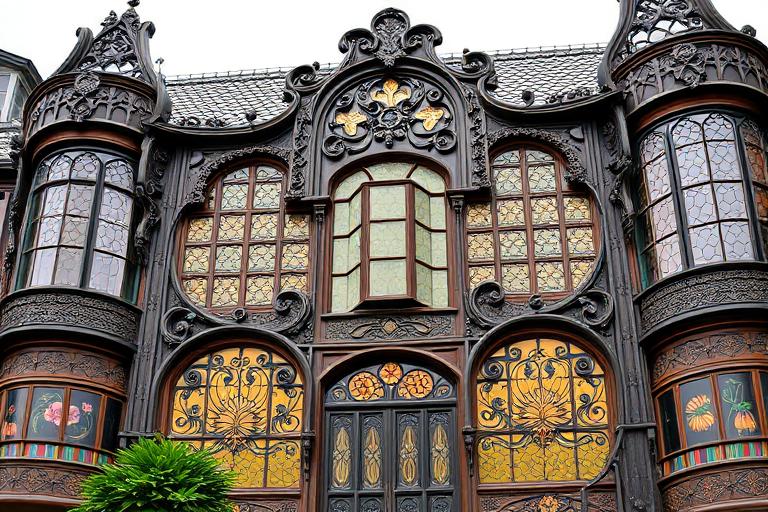
Example of the Art Nouveau aesthetic
Archive platearch art nouveau

Source document

Registrar's index cards on the platen glass — captured by the scanner

Elio Archive — Registrar's OfficeArt NouveauFILE 020-AA
When to use it
  • Brand identity built on organic elegance, craft, and the sinuous line
  • Editorial and packaging for beauty, fragrance, and botanical brands
  • Decorative systems where ornament is the message, not a crime
  • Poster and lettering work channeling fin-de-siècle romanticism
Perfect for
  • Heritage luxury, beauty, and fragrance houses
  • Boutique hospitality with a decorative, sensual atmosphere
  • Craft studios, ceramicists, and decorative artists
  • Cultural institutions covering the decorative arts
What it looks like
  • Victor Horta — Hôtel Tassel, Brussels (1893)
  • Hector Guimard — Paris Métro entrances (1900)
  • Antoni Gaudí — Casa Batlló, Barcelona (1906)
  • Otto Wagner — Majolica House, Vienna (1898)

Aesthetic profile

8-channel console — dominant channels taped & circled by the registrar

Attribute Console — 020-AA 8 CH ACTIVEFIG. 1
CH01Minimal
MaximalR·50
CH02Analog
DigitalL·60
CH03Restrained
ExpressiveR·60
CH04Cool
WarmR·30
CH05Futuristic
NostalgicR·50
CH06Structured
ChaoticR·20
CH07Dark
LightR·20
CH08Organic
GeometricL·80

strongest channels circled — leans organic, analog, expressive ✦

Profile card

Your aesthetic passport — share the fingerprint

Aesthetic Profile
Art Nouveau
Early Modern
1890–1910
MaximalAnalogExpressiveWarmNostalgicChaoticLightOrganic
OrganicAnalogExpressive7 materials
eliosignal.com/styles/arch-art-nouveau

Material assembly

The style's primary materials, assembled bottom-up

Tap a stratum for material detail · Full catalog

Place in history

Early Modern · 1890–1910 — tap any style to travel

Mood Board

Sign in to generate

Sign in to generate a mood board

Sign in

Editorial Depth

Sign in to unlock

Historical Context
Key Practitioners
What to Avoid

Sign in for editorial depth

Sign in

Cross-references

Architectural ExpressionismArt Deco ArchitectureOrganic ArchitectureGothic Architecture

About this aesthetic

What is the Art Nouveau aesthetic?
Nature set loose in iron and glass — Art Nouveau dissolved the straight line into whiplash curves, tendrils, and organic ornament, from Victor Horta's Brussels townhouses to Hector Guimard's Paris Métro entrances and Gaudí's molten Catalan facades.
When should I use the Art Nouveau aesthetic?
Use it for: Brand identity built on organic elegance, craft, and the sinuous line; Editorial and packaging for beauty, fragrance, and botanical brands; Decorative systems where ornament is the message, not a crime; Poster and lettering work channeling fin-de-siècle romanticism.
What is the Art Nouveau style perfect for?
Perfect for Heritage luxury, beauty, and fragrance houses, Boutique hospitality with a decorative, sensual atmosphere, Craft studios, ceramicists, and decorative artists, Cultural institutions covering the decorative arts.
What does the Art Nouveau aesthetic look like?
Visuals typically feature: Victor Horta — Hôtel Tassel, Brussels (1893); Hector Guimard — Paris Métro entrances (1900); Antoni Gaudí — Casa Batlló, Barcelona (1906); Otto Wagner — Majolica House, Vienna (1898).

Build with the art nouveau aesthetic

Elio turns aesthetic references into on-brand visuals. Generate, compose and publish from one studio.

Join the waitlist