Art Deco Architecture

Jazz-age optimism in stainless steel and gilded terracotta — the Chrysler Building's eagle gargoyles, Rockefeller Center's gilded Prometheus, and the setback zigzag tower that defined the American city between the wars.

Compare Art Deco Architecture with another style →
Record020-AA
AestheticArt Deco Architecture
ClassGeometric / Structured
StatusINGESTING
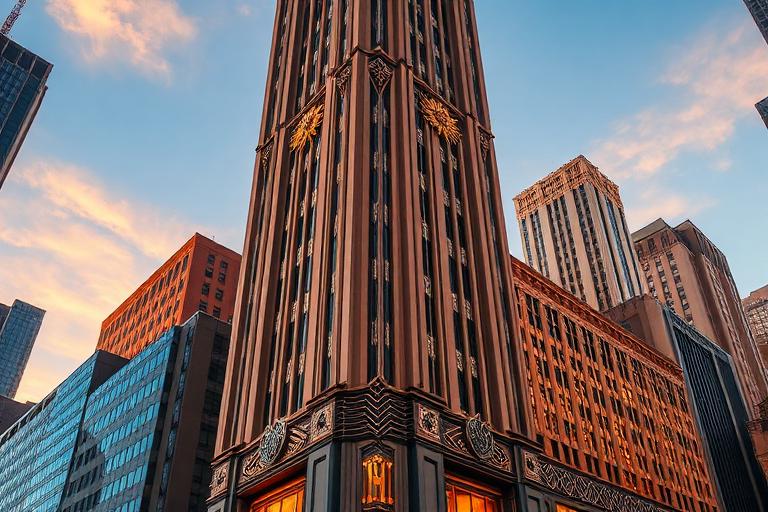
Example of the Art Deco Architecture aesthetic
Archive platearch art deco

Source document

Registrar's index cards on the platen glass — captured by the scanner

Elio Archive — Registrar's OfficeArt Deco ArchitectureFILE 020-AA
When to use it
  • Brand identity evoking interwar glamour, confidence, and decorative ambition
  • Luxury hotel, entertainment, or hospitality brand in or referencing the Art Deco period
  • Fashion and beauty brand mining 1920s–1930s visual culture for contemporary sophistication
  • Cultural institution or performing arts brand in a significant Art Deco building
Perfect for
  • Luxury hotel and resort brands with Art Deco buildings — South Beach, the Savoy, Claridge's
  • Fashion and beauty brands referencing 1920s–1930s glamour
  • Cinema, entertainment, and performing arts venues in Art Deco theaters
  • Jewelry and watchmaking brands communicating geometric precision and interwar luxury
What it looks like
  • William Van Alen — Chrysler Building, New York (1930)
  • Hood, Godley & Fouilhoux — Rockefeller Center, New York (1930–1939)
  • Donald McMorran — Hoover Building, London (1938)
  • Rob Mallet-Stevens — Villa Cavrois, Croix, France (1932)

Aesthetic profile

8-channel console — dominant channels taped & circled by the registrar

Attribute Console — 020-AA 8 CH ACTIVEFIG. 1
CH01Minimal
MaximalR·40
CH02Analog
DigitalL·40
CH03Restrained
ExpressiveR·40
CH04Cool
WarmR·30
CH05Futuristic
NostalgicR·40
CH06Structured
ChaoticL·50
CH07Dark
LightR·30
CH08Organic
GeometricR·70

strongest channels circled — leans geometric, structured, maximal ✦

Profile card

Your aesthetic passport — share the fingerprint

Aesthetic Profile
Art Deco Architecture
Early Modern
1920–1940
MaximalAnalogExpressiveWarmNostalgicStructuredLightGeometric
GeometricStructuredMaximal6 materials
eliosignal.com/styles/arch-art-deco

Material assembly

The style's primary materials, assembled bottom-up

Tap a stratum for material detail · Full catalog

Place in history

Early Modern · 1920–1940 — tap any style to travel

Mood Board

Sign in to generate

Sign in to generate a mood board

Sign in

Editorial Depth

Sign in to unlock

Historical Context
Key Practitioners
What to Avoid

Sign in for editorial depth

Sign in

Cross-references

Stripped ClassicismNeoclassical ArchitectureMid-Century ModernRetrofuturism

About this aesthetic

What is the Art Deco Architecture aesthetic?
Jazz-age optimism in stainless steel and gilded terracotta — the Chrysler Building's eagle gargoyles, Rockefeller Center's gilded Prometheus, and the setback zigzag tower that defined the American city between the wars.
When should I use the Art Deco Architecture aesthetic?
Use it for: Brand identity evoking interwar glamour, confidence, and decorative ambition; Luxury hotel, entertainment, or hospitality brand in or referencing the Art Deco period; Fashion and beauty brand mining 1920s–1930s visual culture for contemporary sophistication; Cultural institution or performing arts brand in a significant Art Deco building.
What is the Art Deco Architecture style perfect for?
Perfect for Luxury hotel and resort brands with Art Deco buildings — South Beach, the Savoy, Claridge's, Fashion and beauty brands referencing 1920s–1930s glamour, Cinema, entertainment, and performing arts venues in Art Deco theaters, Jewelry and watchmaking brands communicating geometric precision and interwar luxury.
What does the Art Deco Architecture aesthetic look like?
Visuals typically feature: William Van Alen — Chrysler Building, New York (1930); Hood, Godley & Fouilhoux — Rockefeller Center, New York (1930–1939); Donald McMorran — Hoover Building, London (1938); Rob Mallet-Stevens — Villa Cavrois, Croix, France (1932).

Build with the art deco architecture aesthetic

Elio turns aesthetic references into on-brand visuals. Generate, compose and publish from one studio.

Join the waitlist